

Peering
Your Mac, from anywhere.
Peering puts your Mac's screen on your iPhone. Over your own network, or through a relay when you are somewhere else. The two devices pair directly, the connection is end-to-end encrypted, and nothing in the middle can read what it carries.
iPhone, and macOS on the Mac you want to reach. Free to use on your own network.
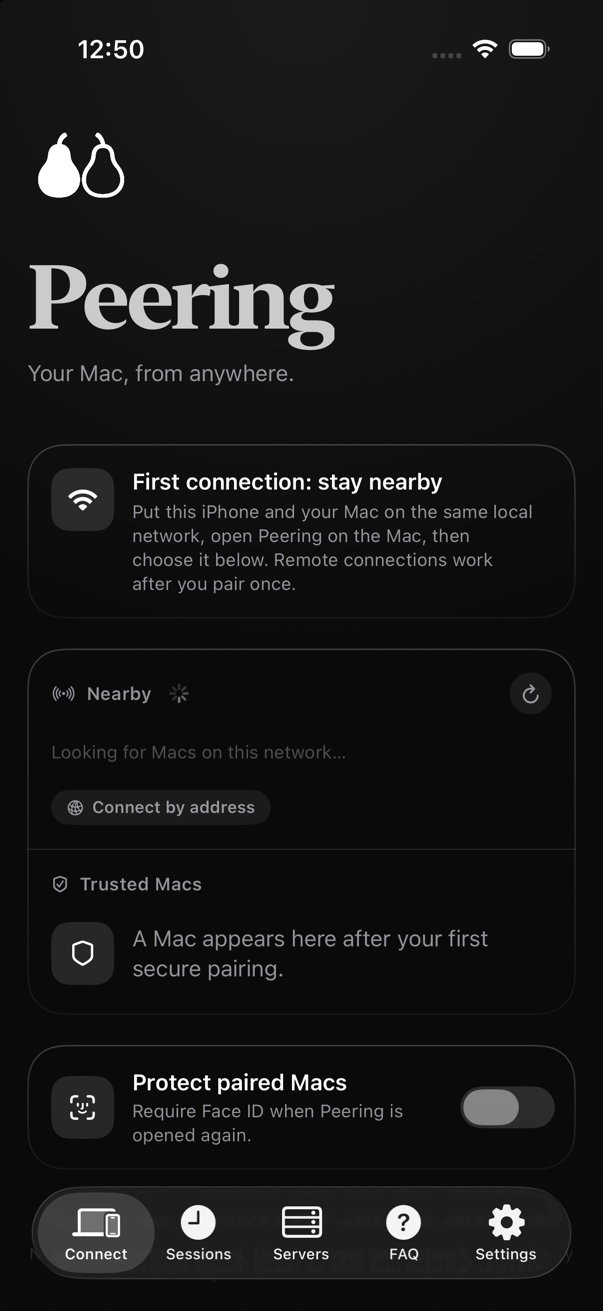
Pair once. Then it is just there.
Three steps the first time, and one step every time after that.
-
1
Pair on your own network
Open Peering on the Mac and pick it from Nearby on the iPhone. Both screens show the same six digits. Confirm only if they match, and the two devices remember each other's keys.
-
2
Choose what to share
A whole display, one running app, or a single window. The list is live, including apps you have not opened yet, and you can switch at any time without dropping the connection.
-
3
Leave the house
After pairing, the relay finds your Mac from other networks. Lock your phone and the session survives; Picture in Picture and a Live Activity keep it in reach.
What it does
Everything below travels over one encrypted connection between your two devices.
Encrypted, device to device
Each device makes its own key and keeps it in its own Keychain. There is no account and nothing stored on a server.
Come back from anywhere
After pairing, an end-to-end encrypted relay reaches your Mac when it is on another network.
You actually drive it
Pointer, keyboard, joystick, scroll wheel and macros. Control & zoom puts your fingers on the Mac.
A screen, an app, or one window
Share any of them, and switch between them without reconnecting.
Every desktop you have
All of your Spaces, each one shown as a picture rather than a list of names.
Keeps going when you leave
Picture in Picture over other apps, a Live Activity on the Lock Screen, and a widget on the Home Screen.
The relay carries it. It cannot read it.
That is a property of how the relay is built, not a promise about how it behaves.
What the relay handles
Your devices' IDs, your Mac's name, the protocol version, which plan the app says you are on, and how much relay time has been used. That is the whole list. It is what addressing two machines and counting allowance requires.
What it cannot read
The control channel is a TLS session belonging to your two devices, copied through without being terminated. Video, audio, keystrokes, pointer input and clipboard text are sealed with keys the relay was never given.
What the app collects
Nothing. No analytics, no advertising, no third-party tracking SDKs, and no account to attach any of it to.
Pricing
Connecting over your own network is free and always will be. The relay is what reaches your Mac from somewhere else, and it is metered.
Free
$0
on your own network
- Unlimited local connections
- Every display, app and window
- Clipboard, keyboard, macros
- Half an hour of relay every day
Relay
$4.99/month
for one Mac
- Everything free has
- Three hours of relay every day
- One paired Mac
Relay Plus
$14.99/month
for two Macs
- Everything in Relay
- Unlimited relay
- Two paired Macs
- Terminal sessions
- Live Activities and widgets
Pro
$79.99/year
everything, billed yearly
- Everything in Relay Plus
- Every Mac you own
- Session audio and Picture in Picture
- Wake on LAN and privacy mode
- Everything added while you are subscribed
Prices are set per country by the App Store and shown in the app before you buy. Subscriptions renew automatically until cancelled, the monthly plans every month and Pro every year. You can cancel any time in your App Store settings.
Questions
Can the relay see my screen or my controls?
No. It forwards the encrypted connection between your paired devices and cannot read the video, audio, clipboard text, keystrokes or pointer input inside it.
What does the relay know about me?
Your Mac's device ID and name, your iPhone's device ID, the protocol version, which plan the app says you are on, and connection usage. A paid connection also sends its relay access key. Nothing else, and no account is involved.
Do I need an account?
No. Peering creates an identity on each device and stores it in that device's Keychain. There is nothing to sign up for and no password.
Why do the two screens show a code?
Each device creates its own key. The six digits are how you confirm that the device you are pairing with is the one in front of you. Once you confirm it, both devices remember the other's public key.
Can I transfer files?
Not yet. Peering carries the screen, Mac audio, controls, terminal commands and clipboard text, but not files.
Does it work on a network I do not control?
Yes. Once paired, the connection uses the relay over the internet, so it works from a hotel, a train, or someone else's Wi-Fi. The local network only has to be shared for the first pairing.